UPDATE! As of 11 AM, diagnosis apparently this project is running all day, web so you can still Tweet to the @CBCOttawa hashtag I discuss below.
This morning, I heard Robyn Bresnahan on the CBC Ottawa Morning radio show telling listeners to Tweet photos of a day in the life of Ottawa before 8:30 AM, so they could win a prize package. I got excited! Then I got lost….
7 Lessons on Hashtag Branding
1. #BALANCE! Brevity, clarity, consistency.
Hashtags are hard. Let me say that first. It’s hard to get a hashtag short enough to be Twitter-friendly but yet intuitive enough that people can clearly see what the Hashtag is about.
But a hashtag for a Twitter project or event is also a BRAND. So as a branding and social media guy, there are a few lessons that I’d like to pull out of this story for those of you who might need to develop hashtags in the future. (Or contact me now if you really need help fast!)
In this case, I wasn’t listening closely to the radio, and by the time I realized I wanted to participate they had moved on to the news. I thought I heard Robyn tell us to hashtag “Heart My Ottawa”, but I wasn’t sure. And since incorrect spelling makes a hashtag useless, I needed to check before I Tweeted.
2. #USEIT! Make sure your people USE the tag first and often.
 Being uncertain,. My first step was to go to the @OttawaMorning stream on Twitter. Turns out, they hadn’t used or mentioned the hashtag at all today. Neither had host @RobynBresnahan, CBC social media guy @Luccidor (who wasn’t at work as I later found out) or a couple of other CBC accounts I checked. And worse, despite the major media push, it wasn’t trending in Ottawa on Twitter either (right).
3. #ABBREVIATEWITHCARE! Use easy-to-interpret short-forms.

So I searched on Twitter specifically for “HeartMyOttawa”. Sure enough, the Tweet at the right came up – the most relevant thing I’d seen yet. But it was the only one.
But then I looked at the embedded CBC Ottawa graphic “Aha!” I thought. It’s supposed to be “#HeartMyCity”. So I searched… and… no luck. #CelebrateOttawa didn’t work either. Neither did #HeartMyOtt, #LoveMyOttawa, or #LuvMyOtt.
So I started thinking, is there a new way to add an actual HEART SYMBOL into a hashtag that I somehow missed…?
4. #YOWDOINGITWRONG! Avoid cool-kid slang.
But then, Robyn came to my rescue on the radio – kind of. She mentioned the contest again. And now I heard it clearly: “#HeartMyYOW“.
Now as most people in Ottawa know, “YOW” is the airport call symbol for Ottawa. And, I knew that along with the “613”area code, YOW is occasionally used as slangy shorthand for Ottawa – but mostly among Twitter power-users. But it’s not as widely used as the much more intuitive “Ott”, as used in long-running hashtags #OttNews #OttWeather #OttPoli or #OttCity. One look, and it’s clear to everyone what “#OttNews” is. “#YOWNews” just doesn’t scan.
So I finally had the right hashtag as of around 7:45 this morning and began using it myself. But even so, there were only a dozen or so Tweets to that tag by that point in the morning – with the 8:30 deadline looming. So I’m guessing I wasn’t alone in having trouble.
5. #CONSISTENTGRAPHICS! Manage the visual ID
But that’s not to say the CBC hadn’t been *trying* to brand and promote the hashtag. They’d used it before in February, and for months it seems, they’d been recruiting partners and local celebs to promote today’s effort – as with this Tweet from last week.
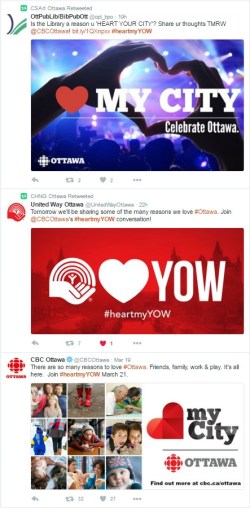 But the technical problems with the hashtag were compounded by a scattered design effort. Take a look at the three graphics on the right. All three are ostensibly supporting the same project. But the visuals are all so different, and the wording so all over the map, that you can understand how those of very little Monday morning brain (like me) could get confused.
If #HeartMyYOW is the tagline, and the whole project is meant to happen on Twitter, “#HeartMyYOW” needs to be the headline, logo, and call-to-action everywhere. And the visuals need to be packaged and managed like a brand for maximum impact.
6. #IFYOUTAGITOWNIT! Be part of the conversation.
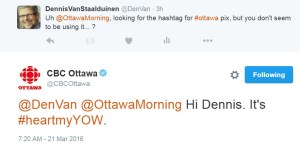 Apart from making sure staff and social media accounts had been using the hashtag correctly before the conversation/event, it helps to ensure there is a human being actively engaging on the hashtag during the intended window of activity – particularly if that window is before 8:30 AM on a Monday morning (which, by the way, is not a great time to ask for photos of the city – as most people are either just waking up, having their coffee, or commuting).
The @CBCOttawa main account did get back to me as you can see – shortly after I’d figured it out for myself. As did @RobynBresnahan herself. So credit where credit is due – and thanks for the help!
7. #TALKTOME! Branding and social media are what I do.
In the end, eventually several dozen people did actually manage to Tweet their photos to #HeartMyYOW before the deadline. So this wasn’t a failed project by any stretch. But it could have been more successful, with a bit of help.
And that’s where I come in. I’m a branding guy AND a social media advisor (geek) AND a really active community promoter in Ottawa. So please please talk to me or Tweet to @DenVan if you have a local project you’d like to promote on social media, a Twitter hashtag dilemma, or just want to bounce an idea around! I’m happy to offer a few words of branding or social media advice to worthy causes, charities, and public good groups for free – EVEN THE CBC!!
If it’s a larger strategy project, training session, or if you need advice for your for-profit company, contact me anyway! For you, I’ll be happy to let you buy me coffee/lunch/beer and give you some thoughts, and a quote for more of my professional time and energy.